3-30-1999 VERSION 1.3
|
3-30-1999 VERSION 1.3 |
Please send any additions or corrections to this list to :

  *        /|\               *     Mark Anderson
          / | \     *              multichannel AT cox.net
 *       /  |  \
  ------/   |   \---------------
       /    |    \
            |
This list can be accessed from :
http://www.surrounddiscography.com/


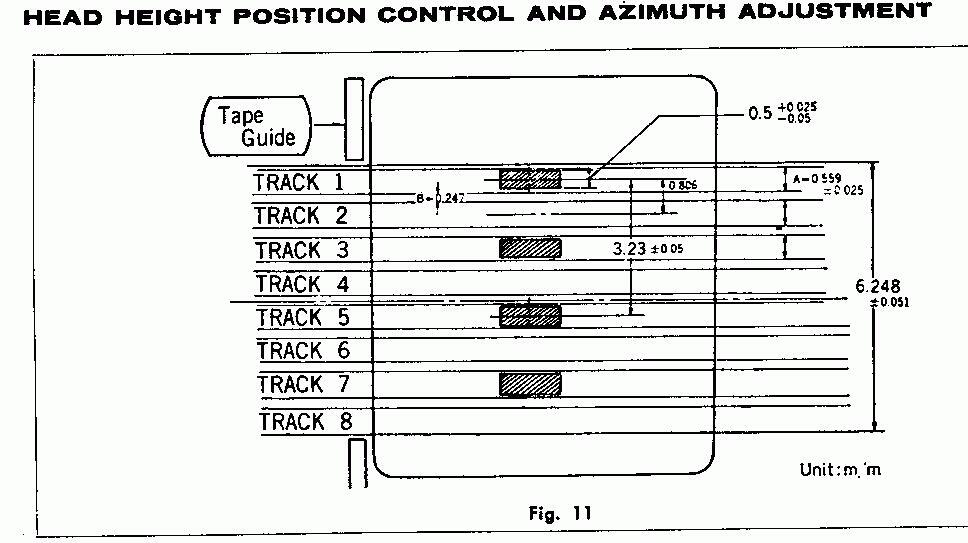
Quad 8-track head layout


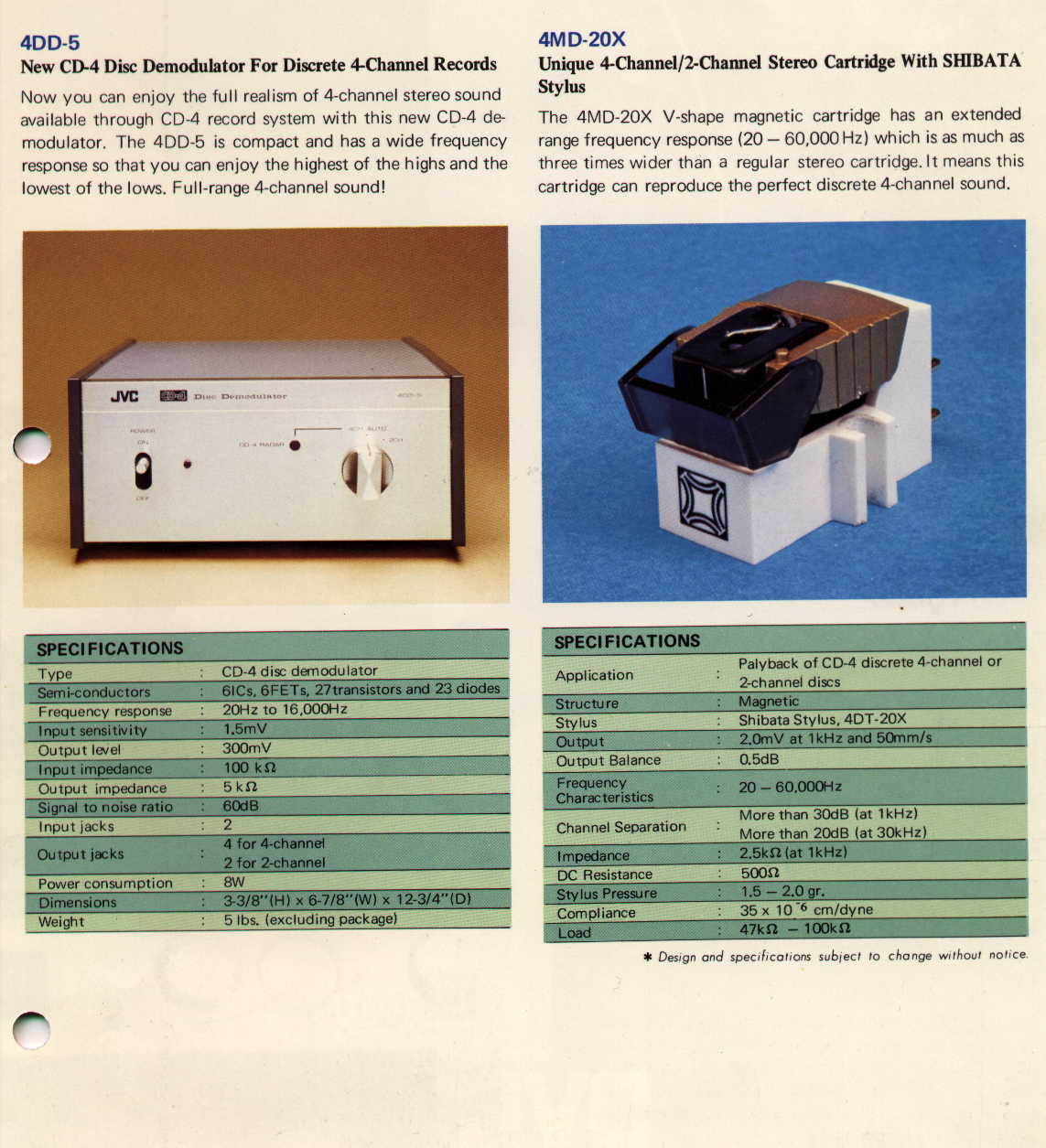
JVC's CD-4 Quadraphonic Compatable Disc Format


CD-4 Quadraphonic Equipment


  There were several so called "matrix" systems, where the four
channels of quadraphonics were encoded into two channels and decoded
back to four.  At least this was the intention.  But the egg theory
applies:  If you take four chicken eggs and break them in a bowl, you
can see at the bottom, four yellow rounds and the clear stuff around
them.  The moment you stick in your fork and mix them, the yellows get
broken and it becomes VERY difficult to put them back together again.
You possibly could portion the yellow stuff in four equal cups, but
the other stuff is mixed with the yellow already.  This was the sad
state of the early quad matrix decoders.....many of them resembled four-
channel MONO or at best DOUBLE-STEREO upon decoding/playback.
Interchannel separation was 3-10db (worse than the average 25db of a
normal stereo recording).  It took years of development to perfect
the "Logic"  circuits required to properly decode the matrix , and by
the time the really good logic decoders came to market, it was around
1979 and way too late to save quad from doom!  But, the end-stage
decoders like the TATE II, Audionics Space & Image Composer, and the
Sansui Vario-Matrix units are capable of 35-40db of separation!
   Although multi-channel sound has been experimented with both for
audio and in movies since at least the 1930s, it wasn't until 1969
that technology and the audio industry were ready to commercialize it.
At the AES meeting in 1969 Vanguard records demonstrated DISCRETE
four-channel sound on a four-channel reel to reel deck.  Heads turned,
production geared up and the first home quad recordings on open reel
tape were released in 1970.
   Immediately following this...two developments are key, the
introduction of quadraphonic 8-track tapes (easily re-engineered from
the stereo 8-tracks of the day) and the quest for some way to get
quadraphonics into the commercial medium of the day........the lp.
  Peter Scheiber is credited with inventing the basic mathematical
matrix to encode four-channels into two, and then decode them back to
four which he demonstrated in 1970 at the annual AES meeting.  CBS
bought the rights and named it SQ for Surround Quadraphonic.  CBS
went immediately to developing encoders/decoders and re-mixing albums
into quadraphonic from their master-tape library.  SQ rolled out in 1972
to great fanfare with units from Sony, Fisher, Lafayette, Marantz and
Pioneer just to mention a few.
  With CBS as the largest record producer in the US holding the rights,
the other record labels were hesitant to pay "royalties" to their
competitor...so the quest was on for something "better" and "owned" by
ANYONE else.
  JVC of Japan, then a subsidiary of RCA worked on developing a
different method of encoding which resulted in the CD-4 system
(compatible-discrete 4 channel).  CD-4 used a deeper more sharply angled
groove in the record capable of carrying frequencies of 20hz - 45khz to
carry all four channels of information with a 30khz "carrier" frequency
to demodulate the signals back into four channels.  This is the same
method used for FM broadcasting which works great on the radio. But,
vinyl was a different story!  Shibata of Japan developed a stylus
capable of reading the 20-45khz signal, and the encoder/demodulator was
developed....but they had significant problems with the vinyl itself
being able to hold the signals, and degradation due to playing was a
real problem.  JVC then invented their "super" vinyl, and the wear issue
was finally overcome.  Introduction was in late 1973.  RCA now had a
competing format without the royalty headaches..........us consumers now
had the problem!  Also, the "minor" record labels including Number 3,
ABC Records STILL had a problem...pay royalties to RCA or CBS?
  At the same time Peter Scheiber was refining his matrix system,
Isao Itoh of Sansui was developing a very similar system which Sansui
named QS for Quadraphonic-Stereo.  They were really "leading" the pack,
producing their first matrix "synthesizer" in 1970, and following in
1971 with a commercial encoder.  But, being a hardware manufacturer was
both a help and a hindrance!  They couldn't produce any music for the
format!  Sansui offered QS to any and all record producers without any
royalties.......they would make their money on the audio equipment and
decoders!  The minor labels flocked to Sansui.....Vox, Turnabout, Ode,
Ovation, and yep.....ABC!  The War was on...........
  Sansui along with all the other quad encoded formats were submitted
to the Electronic Industry Association of Japan and the Japan Phonograph
Association in 1972 to try and clear up the pending disaster.  After
much animosity the EIA-J and JPA designated the Sansui QS system as the
"regular-matrix" or RM matrix for quadraphonics.  Of course, this was
immediately rejected by CBS and RCA who had too much time and $$
invested in developing their own systems.  And their industry clout in
the US prevented ANY system from being designated the standard in the US.
  The RM designation did have one significant downside for Sansui though.
It allowed all the other "hardware" manufacturers to include an RM
decoder on their units without any royalty being paid to Sansui!
  So, now you know why your Pioneer, or Marantz, or JVC, or just about
any manufacturer OTHER than Sansui has an RM decoder and not a QS
decoder.  The battle raged.........The record producers pushed their
artists and formats.  The hardware manufacturers were stuck trying to
guess which system would prevail and who they should pay for the rights
to produce the decoders in their unit.  And those of us as consumers
busy swapping decoders and trying to hear something great (as we were
told) from the lousy, poor separation SQ and QS decoders of the early
seventies.  Or the alternative, the expensive and difficult to calibrate
CD-4 system that gave us overly sensitive cartridges with plenty of
noise and pops!  Most of the hardware manufacturers lined up behind a
format and prayed that it would make it,and then offered outboard units
for the other formats....just in case they were wrong!
  By 1975 the writing was on the wall.......the Record producers
wouldn't give in, and the Audio companies were willing to do anything to
keep the dream alive.  So it was then that the "second-generation" quad
receivers hit the market....all included SQ, QS (or RM), and CD-4
decoders built-in!   Set up the rest of your system, add your Pioneer
QX-949 or 747, Sansui QRX-7001/8001/9001, Kenwood KR-8840/9940 and play
any of the quad formats in mostly poor SQ, noisy CD-4, or the almost
hidden QS quadraphonic records on your system!
  Quadraphonic record production slowed.......RCA didn't introduce any
new Quadradisc (CD-4) titles after 1975, SQ and QS held on...barely,
with EMI/Angel finally stopping their classical series of SQ in 1979.
  And, the last QS titles were probably the DBX encoded Vox/Turnabout
titles of 1979/80.

"Quad" Bob


Written By : Mr. Bob J Herndon

Inspired By : Eero Aro


List Compiled and Copyright By

Mark Anderson


Back to the Quadraphonic Discography Index Page

Back to the Surround Sound Discography Home Page